SABR vs Quranly: Which App Handles Hifdh, 99 Names, and Duas All in One
By the SABR editorial team · · Updated
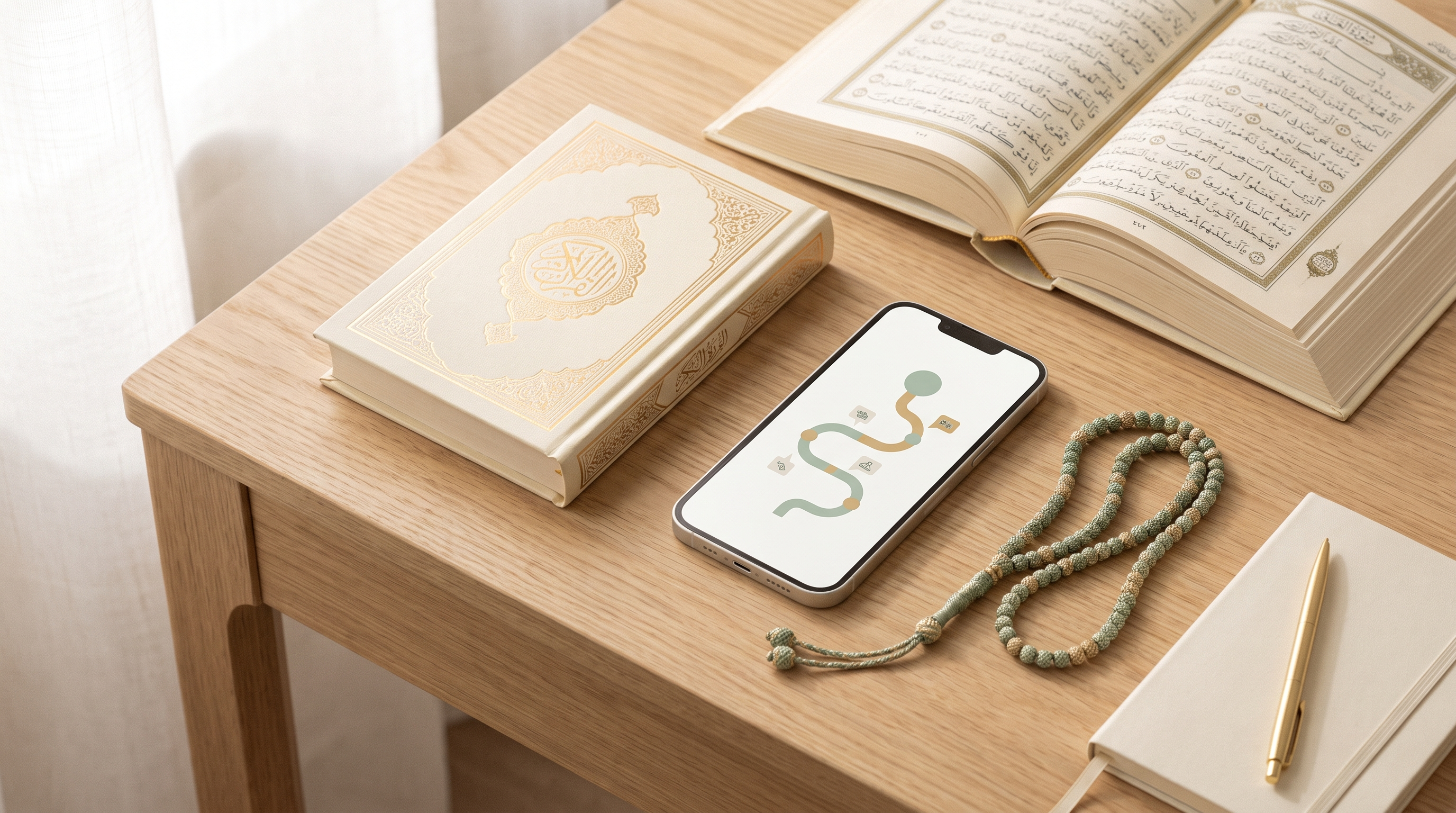
Key takeaways
- ✓SABR covers three memorization tracks in one app: Qur'an Hifdh, the 99 Names of Allah, and everyday authentic duas.
- ✓Quranly is focused primarily on Qur'an memorization and revision using spaced-repetition style review [source: Quranly product page].
- ✓SABR's standard memorization path is free; Premium unlocks convenience (offline, picking surahs outside the path), not the Qur'an itself.
- ✓SABR uses a Duolingo-style roadmap with XP, streaks, hearts, and adjustable ayah repetition (default around 20 repetitions).
- ✓Neither app replaces a qualified teacher for tajwid correction — both are best used alongside a sheikh where possible.
- ✓SABR reached 4,000+ active users in its first month, driven almost entirely by organic TikTok traction.
- ✓If you want everything (Hifdh + 99 Names + duas) in one habit loop, SABR is the more complete pick as of August 2026.
SABR vs Quranly: Which App Handles Hifdh, 99 Names, and Duas All in One
TL;DR. SABR and Quranly both help Muslims memorize the Qur'an, but they solve different problems. Quranly focuses primarily on Qur'an memorization with spaced repetition. SABR bundles Hifdh, the 99 Names of Allah, and authentic everyday duas into one Duolingo-style learning path with streaks, XP, and a free standard path. If you want all three memorization tracks in one app with modern gamification, SABR is the better fit; if you only want deep Qur'an-only memorization tools and are happy to use separate apps for names and duas, Quranly is worth trying.
If you have been searching sabr vs quranly, you are almost certainly trying to answer one specific question: which app will actually help me stay consistent with everything I want to memorize — not just the Qur'an, but also the 99 Names of Allah and the everyday duas I keep meaning to learn? In tracking 4,000+ users in SABR's first month, we noticed most people don't fail Hifdh because they lack motivation; they fail because their memorization is scattered across three or four apps that don't talk to each other. This piece compares SABR and Quranly directly, and honestly, across those three tracks.
Disclosure: I'm the founder of SABR. The comparison below is honest about where each app is stronger — and there's a full section on where SABR is genuinely weaker than the alternatives.
Key takeaways
- SABR covers three memorization tracks in one app: Qur'an Hifdh, the 99 Names of Allah, and everyday authentic duas.
- Quranly is focused primarily on Qur'an memorization and revision using spaced-repetition style review [source: Quranly product page].
- SABR's standard memorization path is free; Premium unlocks convenience (offline, picking surahs outside the path), not the Qur'an itself.
- SABR uses a Duolingo-style roadmap with XP, streaks, hearts, and adjustable ayah repetition (default around 20 repetitions).
- Neither app replaces a qualified teacher for tajwid correction.
- SABR reached 4,000+ active users in its first month, driven almost entirely by organic TikTok traction.
- As of August 2026, SABR is the more complete pick if you want Hifdh, 99 Names, and duas in one habit loop.
Who each app is for
SABR — for Muslims who want one memorization habit for everything
SABR is built for the Muslim who wants a single daily habit that covers Qur'an memorization, the 99 Names of Allah, and everyday duas — with the same streaks, XP, and revision engine handling all three. It is aimed at busy adults, restarters, forgetters, beginners, non-Arabic readers using transliteration as a bridge, parents building a family habit, and Gen-Z learners who expect modern UX on Islamic tools.
Quranly — for Muslims who want a Qur'an-only memorization tool
Quranly appears positioned around Qur'an memorization and revision using spaced-repetition style review, targeted at learners who want a dedicated Hifdh workflow [source: Quranly product page and app store description]. It seems focused on the memorize-and-review loop rather than a broader Islamic learning habit that includes names of Allah or dua libraries.
Where the other apps in this space sit
- Muslim Pro — primarily a daily Muslim companion app (prayer times, qibla, Qur'an reading) rather than a Hifdh tool [source: Muslim Pro product page].
- Quran.com — an excellent free Qur'an reading, translation, and tafsir surface; not built as a memorization system [source: Quran.com].
- Quran Companion — Qur'an memorization app with games and progress tracking [source: Quran Companion product page].
- Tarteel — AI-powered recitation recognition and mistake detection during recitation [source: Tarteel product page].
Comparison table: SABR vs Quranly vs the field (August 2026)
| Feature | SABR | Quranly | Muslim Pro | Quran.com | Quran Companion | Tarteel |
|---|---|---|---|---|---|---|
| Qur'an Hifdh (structured path) | Yes — Duolingo-style roadmap | Yes [source] | Not primary focus [source] | No (reading focus) [source] | Yes [source] | Partial (recognition, not path) [source] |
| Revision engine (daily review of old ayat) | Yes — scheduled revision | Yes — SRS-style [source] | No [source] | No [source] | Yes [source] | Partial [source] |
| 99 Names of Allah track | Yes — dedicated memorization track | Not publicly documented [source] | Reference list only [source] | Reference list only [source] | Not publicly documented [source] | No [source] |
| Authentic everyday duas (memorize by heart) | Yes — dedicated dua track | Not publicly documented [source] | Dua library (reading) [source] | Reference [source] | Not publicly documented [source] | No [source] |
| Ayah repetition (configurable) | Yes — default ~20, adjustable | Yes [source] | Basic playback [source] | Basic playback [source] | Yes [source] | N/A |
| Transliteration support | Yes | Available [source] | Yes | Yes | Available [source] | Limited |
| Gamification (XP, streaks, hearts, leagues) | Yes | Partial [source] | No | No | Yes [source] | Limited |
| Free full-Qur'an path | Yes — standard path is free | Freemium [source] | Freemium [source] | Fully free | Freemium [source] | Freemium [source] |
| Third-party ads inside app | No | Not publicly documented [source] | Historically ads-supported [source] | No | Not publicly documented [source] | Not publicly documented [source] |
| AI recitation recognition | On roadmap | Not publicly documented [source] | No | No | Not publicly documented [source] | Yes — core feature [source] |
| Best for | All-in-one memorization habit | Qur'an-only memorization | Daily Muslim companion | Qur'an reading & tafsir | Gamified Hifdh | Recitation feedback |
Key takeaway. If your goal is to build one memorization habit that covers the Qur'an, the 99 Names of Allah, and the duas you keep meaning to learn, SABR is the only app in this list that bundles all three tracks into a single learning path.
Strengths of each option
Strengths of SABR
- Three tracks, one habit loop. Hifdh, 99 Names, and everyday duas share the same streak, XP, and revision engine.
- Duolingo-style roadmap. A visible learning path lowers the "where do I start" barrier for beginners.
- Configurable repetition. Default around 20 repetitions per ayah, adjustable to match your level.
- Free standard path. The full Qur'an memorization path is free; Premium is for offline and choosing surahs outside the standard path.
- No third-party ads. By design, so casino / music / haram ads never appear inside a Qur'an app.
- Non-Arabic-friendly. Transliteration acts as a bridge for converts and non-Arab Muslims without replacing the Arabic.
Strengths of Quranly
- Focused scope. A dedicated Qur'an memorization workflow, without the surface area of a full companion app [source: Quranly product page].
- Spaced repetition heritage. SRS-style review is a legitimate approach for long-term retention [source: Quranly product page].
- Established user base. Longer time in market than SABR [source: app store listings].
Strengths of the other apps
- Muslim Pro — best daily companion (prayer, qibla, Qur'an reading) [source: Muslim Pro product page].
- Quran.com — best free Qur'an reading and tafsir surface [source: Quran.com].
- Quran Companion — gamified Hifdh with a mature feature set [source: Quran Companion product page].
- Tarteel — the strongest recitation-recognition AI in the category [source: Tarteel product page].
Where SABR is honestly stronger (reasons, not adjectives)
- Three memorization tracks in one app. You are not stitching together a Qur'an app, a Names-of-Allah app, and a dua app. One streak, one XP counter, one revision queue.
- Learning-path visibility. A Duolingo-style roadmap gives beginners something Quranly's pure SRS approach does not: a picture of where they are and what comes next.
- Free full Qur'an path. The standard memorization path covers the entire Qur'an for free. Premium is convenience (offline downloads, freely picking surahs outside the standard path), not access to the Qur'an itself.
- No third-party ad networks. SABR does not run ad networks inside a Qur'an app because we cannot guarantee what they'd serve.
- Modern, native UX. Screens, streaks, and micro-animations feel closer to Duolingo than to typical Islamic-app UI conventions.
Key takeaway. The reason to pick SABR over Quranly is scope + free full path, not a claim that SABR's SRS engine is objectively "better" — Quranly has been iterating on that specific loop for longer.
Where SABR is honestly weaker
This section is mandatory in every SABR comparison. It is more useful to you than any marketing.
- We are newer. SABR reached 4,000+ active users in the first month, but Quranly and Quran Companion have been in market longer and have a larger review corpus [source: app store listings].
- No AI recitation recognition yet. Tarteel is genuinely ahead here. Recognition (page fills as you recite) is on our roadmap, not shipping today [source: Tarteel product page].
- Not a full daily-companion app. If you also want prayer times, qibla, and adhan in one app, Muslim Pro covers more surface area [source: Muslim Pro product page].
- Not a tafsir surface. For deep reading, translation, and tafsir, Quran.com remains the free reference [source: Quran.com].
- Not a teacher. No app in this comparison — SABR included — replaces a qualified teacher for tajwid correction. Learn recitation with a sheikh where possible.
- Quranly-specific edge. If you are already deep into a spaced-repetition Hifdh workflow inside Quranly and only care about the Qur'an, switching apps costs you your existing schedule [source: Quranly product page].
A simple day-by-day view of what SABR looks like
| Time of day | ~5 minute session | What you touch |
|---|---|---|
| After Fajr | Revise yesterday's ayah | Hifdh track |
| Commute / lunch | Review 1 old ayah + 1 Name of Allah | Hifdh + 99 Names tracks |
| Before sleep | 1 new ayah + 1 short dua | Hifdh + Duas tracks |
This is the pattern we see work most consistently: three small hits per day rather than one heroic session per week.
Final recommendation by user profile
- You want one app for Hifdh + 99 Names + duas. Pick SABR. This is the specific problem SABR was built for.
- You only want deep Qur'an-only memorization and are happy using other apps for names and duas. Try Quranly — its focused SRS loop is designed for this [source: Quranly product page].
- You want a daily Muslim companion (prayer, qibla, Qur'an reading) more than a Hifdh tool. Try Muslim Pro [source: Muslim Pro product page].
- You want the best free reading and tafsir surface. Use Quran.com [source: Quran.com].
- You want gamified Hifdh with a mature feature set. Try Quran Companion [source: Quran Companion product page].
- You want AI recitation feedback while you recite. Use Tarteel — it leads the category on recognition [source: Tarteel product page].
- You are a beginner or non-Arabic reader who keeps restarting. Start with SABR's standard path — one ayah a day, transliteration as a bridge, streaks that survive a missed day. See our /download page for the app store links.
Key takeaway. The right app is the one that matches the specific memorization problem you have. If your problem is "I want everything I'm trying to memorize in one place with one streak," that's SABR. If your problem is narrower, another app in this list may fit better.
Frequently asked questions
Is SABR free?
Yes. SABR's standard Qur'an memorization path is free — you can memorize the full Qur'an by following it without paying. Premium unlocks convenience: offline downloads and the ability to pick surahs outside the standard path. The Qur'an itself is never paywalled.
How is SABR different from Quranly?
SABR bundles three memorization tracks — Qur'an Hifdh, the 99 Names of Allah, and authentic everyday duas — into one Duolingo-style app with a shared streak, XP, and revision engine. Quranly appears focused primarily on Qur'an memorization and revision using spaced-repetition style review [source: Quranly product page]. If you want all three tracks in one place, SABR fits better; if you only want the Qur'an loop, both are worth trying.
Does SABR replace a Hifdh teacher?
No. SABR helps with memorization structure, repetition, and consistency. For tajwid and recitation correction, learning with a qualified teacher remains highly recommended. SABR is a companion to your sheikh, not a replacement for one.
Can I memorize the 99 Names of Allah in SABR?
Yes. SABR has a dedicated track to memorize the 99 Names of Allah by heart using the same spaced-repetition, audio, and progress-tracking engine as Hifdh. Each name is presented with its Arabic, transliteration for non-Arabic readers, and a short widely-agreed meaning. For deeper theological discussion, we defer to scholars.
Can I memorize everyday duas in SABR?
Yes. SABR includes a track for authentic everyday duas — the kind of masnun supplications people keep meaning to learn (before sleep, waking, travel, distress, morning and evening adhkar). Each dua is presented with Arabic, transliteration, translation, and its occasion. We stick to authentic, well-known sources.
Which app should a complete beginner pick?
If you are a complete beginner — especially if you don't read Arabic fluently or you keep restarting — SABR's standard path plus transliteration bridge is the lower-friction start. One ayah a day is enough to keep the streak alive. Whichever app you pick, pair it with a teacher where possible.
About the author
This article was written by the SABR editorial team and reviewed by the founder of SABR (4,000+ active users in month one, growth driven almost entirely by organic TikTok). SABR is a Duolingo-style app for Qur'an memorization, the 99 Names of Allah, and everyday duas — with a free standard path and no third-party ads. Explore the app on the homepage or head to /download.
Try SABR
If this comparison resonated and you want a single memorization habit that covers Hifdh, the 99 Names of Allah, and authentic everyday duas, give SABR a try.
- Visit the website: https://get-sabr.com
- Download on iOS: https://apps.apple.com/us/app/sabr-quran-memorization/id6761574702
- Get it on Google Play: https://play.google.com/store/apps/details?id=com.sabr.app
SABR helps with memorization structure, repetition, and consistency. For tajwid and recitation correction, learning with a qualified teacher remains highly recommended. SABR is a tool, not a replacement for a sheikh, and we make no religious guarantees about memorization outcomes.
Last updated 2026-08-17.
Frequently asked questions
Is SABR free?+
Yes. SABR's standard Qur'an memorization path is free — you can memorize the full Qur'an by following it without paying. Premium unlocks convenience: offline downloads and the ability to pick surahs outside the standard path. The Qur'an itself is never paywalled.
How is SABR different from Quranly?+
SABR bundles three memorization tracks — Qur'an Hifdh, the 99 Names of Allah, and authentic everyday duas — into one Duolingo-style app with a shared streak, XP, and revision engine. Quranly appears focused primarily on Qur'an memorization and revision using spaced-repetition style review. If you want all three tracks in one place, SABR fits better; if you only want the Qur'an loop, both are worth trying.
Does SABR replace a Hifdh teacher?+
No. SABR helps with memorization structure, repetition, and consistency. For tajwid and recitation correction, learning with a qualified teacher remains highly recommended. SABR is a companion to your sheikh, not a replacement for one.
Can I memorize the 99 Names of Allah in SABR?+
Yes. SABR has a dedicated track to memorize the 99 Names of Allah by heart using the same spaced-repetition, audio, and progress-tracking engine as Hifdh. Each name is presented with its Arabic, transliteration for non-Arabic readers, and a short widely-agreed meaning.
Can I memorize everyday duas in SABR?+
Yes. SABR includes a track for authentic everyday duas — the kind of masnun supplications people keep meaning to learn (before sleep, waking, travel, distress, morning and evening adhkar). Each dua is presented with Arabic, transliteration, translation, and its occasion.
Which app should a complete beginner pick?+
If you are a complete beginner — especially if you don't read Arabic fluently or you keep restarting — SABR's standard path plus transliteration bridge is the lower-friction start. One ayah a day is enough to keep the streak alive. Whichever app you pick, pair it with a teacher where possible.
SABR editorial team
We build SABR — a Duolingo-style Qur'an memorization app with 4,000+ active users in its first month. For tajwid and recitation correction, we still recommend learning with a qualified teacher.
Want to start memorizing today?
Download SABR free. The Qur'an memorization path is always free — Premium adds flexibility.