How to Memorize Surah Al-Mulk Fast: A 10-Day Evening Plan
By the SABR editorial team · · Updated
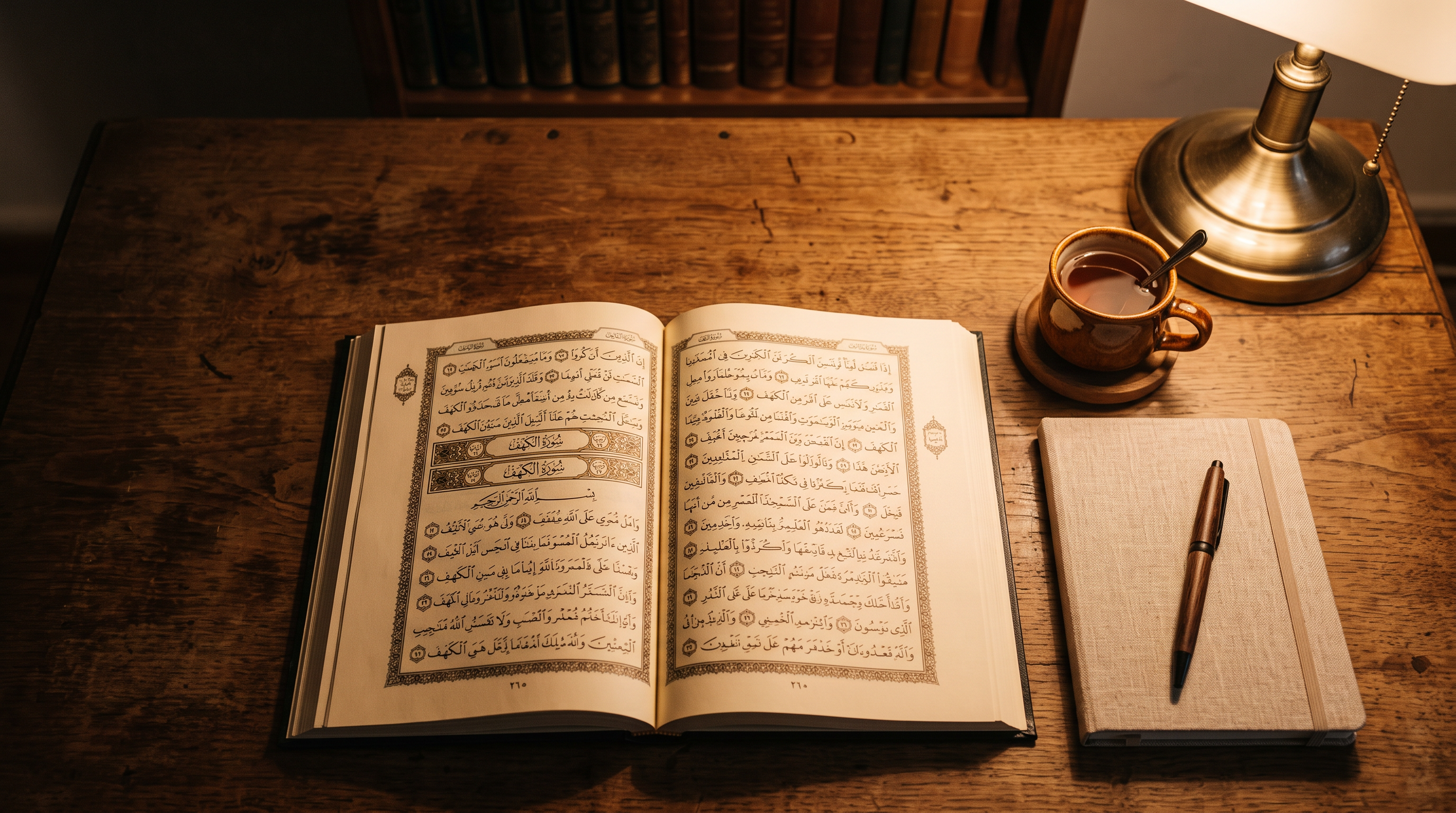
Key takeaways
- ✓Surah Al-Mulk (Chapter 67) contains 30 ayat, most of which are short — making a 10-day plan realistic for most adult learners.
- ✓Split memorization into 3 ayat per evening for 9 nights, and reserve night 10 for continuous full-surah recitation without stopping.
- ✓About 20 focused repetitions per ayah with a slow reciter (Husary, Minshawi Mujawwad) is a common baseline before the ayah 'sticks' overnight.
- ✓Revise the last 3 ayat AND the previous day's 3 ayat before adding new ones — this is the single biggest reason people don't lose the surah in week two.
- ✓If you don't read Arabic fluently, plan for 3-4 weeks and add a listening-only warm-up phase before you attempt to read.
- ✓A qualified teacher is the only reliable path for tajwid correction — an app or plan cannot verify your makharij (letter pronunciation).
- ✓The best time slot for most working adults is between Maghrib and Isha or the 30 minutes after Isha, when phone traffic is lower.
How to Memorize Surah Al-Mulk Fast: A 10-Day Evening Plan
TL;DR. Surah Al-Mulk has 30 ayat and is short enough to memorize in about 10 evenings if you commit to 25-40 focused minutes after Isha. Split the surah into 3 ayat per night for the first 9 nights, then use day 10 for full-surah review. Repeat each new ayah roughly 20 times with a trusted reciter before moving on, and revise the previous day's ayat every night before adding new ones. This plan works best if you already read Arabic slowly; if you don't, add a phonetic pre-step and expect closer to 3-4 weeks.
As of August 2026, Surah Al-Mulk is one of the three most-searched surahs to memorize in SABR's Hifz app, alongside Surah Yasin and Surah Al-Kahf. Across the most common Hifz routines we see, adults who succeed at memorizing it in under two weeks share three habits: a fixed evening slot, a single trusted reciter, and same-day revision. This guide turns those habits into a concrete 10-day plan.
Key takeaways
- Surah Al-Mulk (Chapter 67) contains 30 ayat [source: Quran.com surah page for Al-Mulk], most of which are 5-10 words long — making a 10-day plan realistic for most adult learners.
- Split memorization into 3 ayat per evening for 9 nights, and reserve night 10 for continuous full-surah recitation without stopping.
- About 20 focused repetitions per ayah with a slow reciter (Husary, Minshawi Mujawwad) is a common baseline before an ayah is stable overnight.
- Revise the last 3 ayat AND the previous day's 3 ayat before adding new ones — this is the single biggest reason people don't lose the surah by week two.
- If you don't read Arabic fluently, plan for 3-4 weeks and add a listening-only warm-up phase before you try to read.
- A qualified teacher is the only reliable path for tajwid correction. An app or plan cannot verify your makharij.
- The best evening slot for working adults is between Maghrib and Isha, or the 30 minutes after Isha.
Why Surah Al-Mulk, and why 10 days is realistic
Surah Al-Mulk is 30 ayat spread across roughly two pages of the standard Madinah mushaf [source: King Fahd Complex mushaf pagination]. Its ayat are mostly short and rhythmic, and many Muslims have already heard it recited — either in Ramadan taraweeh or as a nightly Sunnah recitation before sleep, a practice widely reported in the hadith literature [source: authentic hadith on nightly recitation of Al-Mulk].
That combination — short length, familiar sound, common exposure — is what makes 10 evenings a realistic target. Compare it to Surah Yasin (83 ayat) or Al-Kahf (110 ayat), where a 10-day plan is not appropriate for most adult beginners.
Honest caveats before you start:
- If you cannot yet read Arabic with tashkeel (harakat) at a slow steady pace, treat the plan below as 20 days, not 10, and use the first half for a listening-and-reading warm-up.
- If you have never memorized any surah longer than Al-Kafirun, expect the first two nights to feel disproportionately hard. That's normal.
- Memorizing quickly and retaining the surah are two different projects. This guide covers both, but the retention piece continues past day 10.
The daily routine (25-40 minutes)
Use the same evening slot every night. Consistency of time matters more than consistency of duration.
The four-block session
| Block | Time | What you do |
|---|---|---|
| 1. Warm-up | 3-5 min | Listen once to today's target ayat by a slow reciter — eyes on the mushaf, not reciting yet |
| 2. Old revision | 5-8 min | Recite yesterday's 3 ayat from memory, twice through |
| 3. New memorization | 12-20 min | Work through today's 3 new ayat, one at a time, ~20 repetitions each |
| 4. Consolidation | 5-7 min | Recite today's 3 new ayat back-to-back, without the mushaf, three times |
Do not skip block 2. It is the block that decides whether you still know the surah in six weeks.
Key takeaway. Yesterday's 3 ayat are the fragile ones — not today's. Revising them before you touch new material is what turns short-term recall into stable memory.
The 10-day split
| Night | Ayat | Cumulative |
|---|---|---|
| 1 | 1-3 | 3 |
| 2 | 4-6 | 6 |
| 3 | 7-9 | 9 |
| 4 | 10-12 | 12 |
| 5 | 13-15 | 15 |
| 6 | 16-18 | 18 |
| 7 | 19-21 | 21 |
| 8 | 22-24 | 24 |
| 9 | 25-27 | 27 |
| 10a | 28-30 | 30 |
| 10b | Full surah review | 30 |
On night 10 you learn the final 3 ayat, then recite the full surah once from memory before sleeping. Expect this last recitation to be slow and clumsy. That is fine.
Repetition recommendation
Around 20 focused repetitions per ayah is the baseline most SABR users converge on when we ask them what worked. It is not a magic number; it is what "enough" tends to look like for short, unfamiliar ayat when the learner is paying attention.
A practical structure inside block 3:
- Listen to the ayah once (reciter's voice, eyes on the words).
- Recite it 5 times with the mushaf open.
- Recite it 5 times with your eyes closed.
- Recite the previous ayah + the new one together, 5 times.
- Recite all today's new ayat so far, back-to-back, until you can do it twice without stopping.
If you are still stumbling after 30 repetitions, the ayah is not the problem — your attention is. Stop, drink water, and come back in five minutes. Longer sessions with divided attention are worse than shorter sessions with focus.
Adjust the count if:
- The ayah is short (5-6 words): 12-15 repetitions may be enough.
- The ayah is longer or contains unfamiliar words: push to 25-30.
- You memorized the same ayah in the past and half-remember it: 8-10 repetitions is often sufficient to restore it.
Revision schedule (during and after the 10 days)
Memorizing without a revision schedule is how people lose Al-Mulk in three weeks. Here is the schedule we recommend, split into the memorization phase and the retention phase.
During the 10 days
- Every night, before new material: recite yesterday's 3 ayat from memory, twice.
- Every 3 nights: recite the whole cumulative portion so far, once.
- Night 10: full surah, once.
Weeks 2-4 (retention phase)
| Frequency | What to recite |
|---|---|
| Daily | Full surah, once (any time — walking, driving, before sleep) |
| Twice a week | Full surah with the mushaf open, checking for mistakes |
| Once a week | Full surah out loud to another person if possible |
After 30 days of daily recitation, Al-Mulk usually settles into what SABR users describe as "automatic" — the surah plays back with minimal effort. At that point you can drop to 3-4 recitations a week and add a new surah.
Key takeaway. Fast memorization plans fail on retention, not on acquisition. Budget as many days for revision after day 10 as you spent memorizing.
Common mistakes
- Switching reciters mid-plan. Your brain memorizes both the words and the melody. Pick one reciter — Husary or Minshawi Mujawwad are common choices for beginners — and stay with them for all 10 days.
- Skipping block 2 (yesterday's revision) because "I still remember it." You remember it today. Block 2 is what makes you remember it in six weeks.
- Doing more than 3 ayat on "strong" days. Piling on 6 ayat on day 3 usually means skipping day 4. Consistency beats bursts.
- Learning in bed while sleepy. The last 10 minutes before sleep are useful for a passive listen, not for new memorization.
- Ignoring tajwid entirely because you're focused on speed. You will re-memorize with the mistakes baked in. See the next section.
- No plan for missed days. Life happens. If you miss a day, do NOT double up. Repeat the previous day's ayat and shift the schedule forward by one day.
When to ask a teacher
A plan and an app can help you build the routine. They cannot verify how you are actually pronouncing the words. The following situations mean you should stop and consult a qualified teacher or reciter before continuing:
- You are unsure of the makharij (articulation points) of letters like ض, ظ, ع, ح, or ق.
- You cannot yet read a new ayah with tashkeel without significant guessing.
- You have never had your recitation heard by someone qualified.
- You are memorizing for the purpose of leading prayer (imamah).
- You feel a specific ayah "doesn't sound right" but can't tell why.
SABR is built to help with structure, repetition, and consistency. It does not — and should not — replace a teacher for tajwid correction. Even 30 minutes a week with a qualified reciter, on video, materially changes the quality of what you memorize.
Frequently asked questions
How long does it realistically take to memorize Surah Al-Mulk?
For an adult who reads Arabic slowly and can commit 25-40 focused minutes a night, 10-14 evenings is realistic for acquisition, followed by 3-4 weeks of daily recitation to reach stable retention. If you don't yet read Arabic, plan for 3-6 weeks including a listening-and-reading warm-up phase.
Can I memorize Surah Al-Mulk without a teacher?
You can memorize the words without a teacher, but you cannot verify your tajwid without one. For personal recitation this may be acceptable to you; for leading prayer or teaching others, working with a qualified reciter is strongly recommended. Many online teachers now offer 30-minute weekly sessions specifically for correction.
Should I memorize with translation or Arabic only?
Memorize the Arabic. Read the translation of today's ayat once before the session so you have a rough sense of meaning, then set the translation aside during block 3. Mixing translation into repetition slows acquisition without materially improving retention.
What time of day is best?
Between Maghrib and Isha, or the 30 minutes immediately after Isha, are the most commonly reported successful slots for working adults. Early morning after Fajr is also excellent if you can stay awake. What matters most is picking one slot and keeping it consistent for all 10 days.
What if I miss a day?
Do not double up the next day. Repeat the previous day's 3 ayat as your "new" material and slide the whole schedule forward by one day. A 12-day plan you actually finish is better than a 10-day plan you abandon on day 6.
Which reciter should I use to memorize from?
Slow, clear reciters designed for teaching are best: Sheikh Mahmoud Khalil Al-Husary (mu'allim / teaching version) and Sheikh Mohamed Siddiq Al-Minshawi (mujawwad) are the two most common choices. Avoid fast recitations for memorization even if they are your favourite for listening.
Bring the plan into a daily habit
SABR is a Duolingo-style Qur'an memorization app that turns plans like this one into a daily routine with repetition, revision reminders, streaks, and progress tracking. The standard learning path — including all 30 ayat of Surah Al-Mulk — is free. Premium unlocks convenience features like offline downloads and freely picking surahs outside the standard path.
If you want to run this 10-day plan inside a structured app:
- Visit get-sabr.com to see how the memorization path works.
- Download on iOS: https://apps.apple.com/us/app/sabr-quran-memorization/id6761574702
- Get it on Google Play: https://play.google.com/store/apps/details?id=com.sabr.app
- Or start from our download page for both stores in one place.
Related reads on the SABR blog: how to stop forgetting surahs and best Quran memorization routine for busy Muslims.
About the author
This article was written by the SABR editorial team and reviewed by the founder of SABR, a Duolingo-style Qur'an memorization app with 4,000+ active users in its first month. SABR helps with memorization structure, repetition, and consistency. For tajwid correction and recitation review, learning with a qualified teacher remains strongly recommended.
Last updated 2026-08-16.
Frequently asked questions
How long does it realistically take to memorize Surah Al-Mulk?+
For an adult who reads Arabic slowly and commits 25-40 focused minutes a night, 10-14 evenings is realistic for acquisition, followed by 3-4 weeks of daily recitation to reach stable retention. If you don't yet read Arabic, plan for 3-6 weeks including a listening-and-reading warm-up.
Can I memorize Surah Al-Mulk without a teacher?+
You can memorize the words without a teacher, but you cannot verify your tajwid without one. For personal recitation this may be acceptable; for leading prayer or teaching, working with a qualified reciter is strongly recommended. Many teachers now offer 30-minute weekly correction sessions online.
Should I memorize with translation or Arabic only?+
Memorize the Arabic. Read the translation of today's ayat once before the session so you have a rough sense of meaning, then set the translation aside during repetition. Mixing translation into repetition slows acquisition without materially improving retention.
What time of day is best?+
Between Maghrib and Isha, or the 30 minutes after Isha, are the most commonly reported successful slots for working adults. Early morning after Fajr also works well if you can stay awake. Consistency of the same slot matters more than which slot you pick.
What if I miss a day?+
Do not double up the next day. Repeat the previous day's 3 ayat as your new material and slide the whole schedule forward by one day. A 12-day plan you actually finish is better than a 10-day plan you abandon on day 6.
Which reciter should I use to memorize from?+
Slow, clear reciters designed for teaching are best: Sheikh Mahmoud Khalil Al-Husary (teaching version) and Sheikh Mohamed Siddiq Al-Minshawi (mujawwad) are two common choices. Avoid fast recitations for memorization even if they are your favourite for listening.
SABR editorial team
We build SABR — a Duolingo-style Qur'an memorization app with 4,000+ active users in its first month. For tajwid and recitation correction, we still recommend learning with a qualified teacher.
Want to start memorizing today?
Download SABR free. The Qur'an memorization path is always free — Premium adds flexibility.