Best Quran Memorization Apps for iPad: Big-Screen Hifz Setups Reviewed
By the SABR editorial team · · Updated
Key takeaways
- ✓iPad screens change how Hifz apps should be judged — split-view, Apple Pencil support, and reciter audio quality matter more than on phones.
- ✓SABR is our top pick for beginners and busy Muslims who need a structured daily routine with repetition, revision, streaks, and a clear learning path.
- ✓Quran Companion is the most established classical Hifz methodology app, built around traditional revision cycles.
- ✓Tarteel uses AI recitation recognition and is the best option if your priority is real-time pronunciation feedback.
- ✓Quran.com's iPad app is the strongest free reading + translation experience but is not built for memorization specifically.
- ✓Muslim Pro is a general Muslim companion (prayer times, qibla, adhkar) — not a memorization app, and we do not recommend it as your primary Hifz tool.
- ✓No app replaces a qualified teacher for tajwid correction; treat every app on this list as a routine-support layer, not a sheikh.
Best Quran Memorization Apps for iPad: Big-Screen Hifz Setups Reviewed
TL;DR. The best Quran app for iPad depends on the job you're doing. For structured Hifz with a Duolingo-style roadmap and revision, SABR is our top pick for beginners and busy learners. For classical Hifz methodology, Quran Companion is the most established. For AI-powered recitation feedback, Tarteel leads. Quran.com is the strongest free reading experience on the big screen. Muslim Pro is a general Muslim companion app, not a memorization tool. As of July 2026, no single app does everything — most serious learners end up pairing two.
Key takeaways
- iPad screens change how Hifz apps should be judged — split-view, Apple Pencil support, and reciter audio quality matter more than on phones.
- SABR is our top pick for beginners and busy Muslims who need a structured daily routine with repetition, revision, streaks, and a clear learning path.
- Quran Companion is the most established classical Hifz methodology app, built around traditional revision cycles.
- Tarteel uses AI recitation recognition and is the best option if your priority is real-time pronunciation feedback.
- Quran.com's iPad app is the strongest free reading + translation experience but is not built for memorization specifically.
- Muslim Pro is a general Muslim companion (prayer times, qibla, adhkar) — not a memorization app, and we do not recommend it as your primary Hifz tool.
- No app replaces a qualified teacher for tajwid correction; treat every app on this list as a routine-support layer, not a sheikh.
Founder disclosure
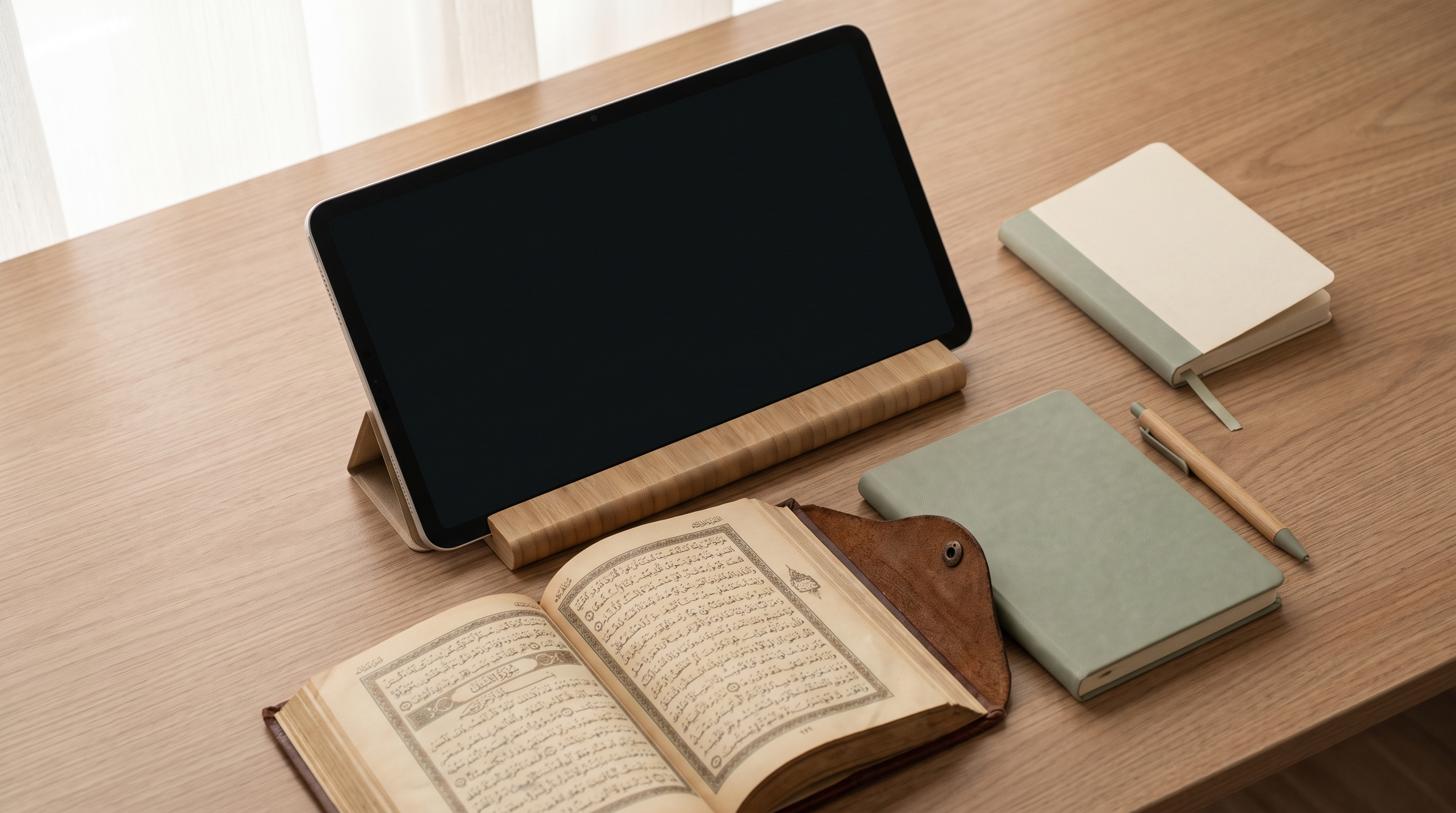
Disclosure: I'm the founder of SABR. SABR is one of the six apps compared below. In tracking 4,000+ users in SABR's first month, we spent a lot of time watching how people actually use Hifz apps on iPad — often propped up next to a physical mushaf or split-screened with notes. The comparison below is deliberately honest about where each app is stronger, including where SABR is genuinely weaker than the alternatives. Every competitor claim we couldn't verify from our own use is marked with a [source: ...] placeholder so it can be checked before you rely on it.
What actually matters when picking a Hifz app for iPad
Most "best Quran app" lists were written for phones, then re-published for iPad without changing the criteria. That's a mistake. On the iPad, the job-to-be-done shifts:
- Big-screen mushaf legibility. A whole page of the Madinah mushaf fits comfortably. Apps that upscale phone layouts feel wasted.
- Split-view workflows. Serious learners often keep notes, a dictionary, or a teacher's video call open next to the app.
- Apple Pencil. Marking waqf signs, underlining a difficult ayah, or annotating a page is much easier with a stylus.
- Audio hardware. iPads have better speakers than most phones. Reciter quality and playback controls matter more.
- Session length. iPad sessions tend to be longer (15–30 minutes) than phone sessions (3–7 minutes). Fatigue-friendly UI wins.
With those criteria in mind, here's how the six most-searched apps actually compare in 2026.
1. SABR — best for structured daily Hifz with revision and streaks
SABR is a Duolingo-style Qur'an memorization app with a clear learning path, repetition per ayah, scheduled revision of older ayat, streaks, XP, and reminders. On iPad, the roadmap view breathes properly and the reciter audio player is easier to control mid-session.
Who it's for: Beginners, restarters, busy adults, and anyone who has memorized in the past but keeps forgetting because they never had a revision system.
Strengths:
- Structured learning path with ayah-by-ayah progression — you always know what to do next.
- Configurable repetition count per ayah (default around 20) so you can tune to your level.
- Built-in daily revision scheduler that mixes new ayat with older ones automatically.
Best for persona: The busy Muslim who wants a 15-minute daily routine that survives a missed day.
Pricing facts: The standard learning path is free — the full Qur'an can be memorized without paying. Premium unlocks convenience features (offline downloads, picking surahs outside the standard path). No third-party ads. [source: SABR pricing page on get-sabr.com]
Key takeaway. SABR is the right pick if the reason you keep failing at Hifz is inconsistency, not lack of desire — the app is built around "come back tomorrow" more than "memorize fast today."
2. Quran Companion — best for classical Hifz methodology
Quran Companion is one of the longest-standing Hifz-specific apps and is often recommended by traditional Hifz students. It appears focused on classical revision cycles (sabaq, sabqi, manzil) rather than gamified habit formation.
Who it's for: Learners already inside a classical Hifz framework, or students of a sheikh who follows the traditional methodology.
Strengths:
- Structured around the classical three-part revision cycle familiar to madrasah students. [source: Quran Companion features page]
- Long track record — has been used by serious Hifz students for years. [source: Quran Companion App Store listing]
- Includes reciter audio, page-by-page memorization tracking, and progress statistics. [source: Quran Companion features page]
Best for persona: The serious Hifz student who already has a teacher and wants a digital layer on top of a classical routine.
Pricing facts: Freemium — premium tier not publicly documented at the level of detail we can verify. [source: Quran Companion pricing page]
3. Tarteel — best for AI-powered recitation feedback
Tarteel's core feature is real-time recitation recognition — the app listens as you recite and highlights the page as you go, flagging mistakes. On iPad, the larger microphone array and screen make this feel more natural than on a phone.
Who it's for: Learners whose main gap is recitation accuracy — people who can memorize but aren't sure if what they memorized is pronounced correctly.
Strengths:
- AI recitation recognition that fills the mushaf page as you recite. [source: Tarteel product page]
- Mistake detection during recitation to flag where you paused or misread. [source: Tarteel product page]
- Voice-driven navigation reduces the need to tap through the mushaf. [source: Tarteel product page]
Best for persona: The intermediate learner who has some memorization but wants recitation feedback between teacher sessions.
Pricing facts: Free tier with limited features; premium subscription unlocks unlimited recitation and additional tools. Exact price tiers not publicly documented at time of writing. [source: Tarteel pricing page]
Key takeaway. Tarteel is a recitation-feedback app more than a memorization-planning app. Pair it with a memorization tool rather than expecting it to replace one.
4. Quranly — best for gamified daily reading goals
Quranly is positioned as a habit-tracking Quran app with daily reading goals, streaks, and community features. On iPad, the daily-goal UI is easy to glance at and the reader is comfortable for longer sessions.
Who it's for: People whose primary goal is daily Quran reading consistency — with memorization as a secondary outcome rather than the main feature.
Strengths:
- Daily reading goals with streak tracking. [source: Quranly App Store listing]
- Community and social accountability features. [source: Quranly product page]
- Clean, modern iPad-friendly UI. [source: Quranly App Store listing]
Best for persona: The Muslim who wants to rebuild a daily reading habit and is not yet ready to commit to a structured Hifz plan.
Pricing facts: Freemium with a paid tier — exact pricing not publicly documented at the detail level we can verify. [source: Quranly pricing page]
5. Quran.com iPad app — best free reading + translation experience
The official Quran.com app is the strongest general-purpose Quran reader on iPad. It's not built for memorization, but many learners use it as their reading surface and pair it with a dedicated Hifz app.
Who it's for: Anyone who wants a clean, ad-free mushaf with high-quality reciter audio and multiple translations, on a big screen.
Strengths:
- Free, ad-free, non-profit — no monetization pressure inside the reading experience. [source: Quran.com about page]
- Multiple translations and tafsir integrations. [source: Quran.com features page]
- High-quality reciter library with word-by-word audio. [source: Quran.com features page]
Best for persona: Any learner who wants a beautiful primary reading surface, regardless of which Hifz app they use alongside it.
Pricing facts: Free, non-profit. No paid tier. [source: Quran.com about page]
6. Muslim Pro — general companion, not a Hifz app
We include Muslim Pro because people often search for it in this category, but it belongs in a different one. Muslim Pro appears focused on prayer times, qibla, adhkar, and general Islamic content. It is not designed as a memorization tool.
Who it's for: Muslims who want a general-purpose daily Islamic companion (prayer times, hijri calendar, adhkar reminders).
Strengths:
- Accurate prayer times and qibla direction. [source: Muslim Pro App Store listing]
- Adhkar and daily reminder features. [source: Muslim Pro App Store listing]
- Widely established and translated into many languages. [source: Muslim Pro product page]
Best for persona: Someone who wants an all-in-one prayer + Quran + adhkar app and is not specifically trying to memorize.
Pricing facts: Freemium with a premium tier and, historically, third-party advertising in the free tier. [source: Muslim Pro pricing page]
Honest comparison matrix
| App | Best for | Learning path | Structured revision | AI recitation | Free full-Quran memorization | iPad-optimized |
|---|---|---|---|---|---|---|
| SABR | Structured daily Hifz | Yes (Duolingo-style) | Yes (built in) | No | Yes (standard path is free) | Yes |
| Quran Companion | Classical Hifz methodology | Yes (sabaq / sabqi / manzil) | Yes (classical cycle) | Not publicly documented | Not publicly documented | Yes |
| Tarteel | Recitation feedback | Partial | Limited | Yes (core feature) | Free tier limited | Yes |
| Quranly | Daily reading habit | No (goal-based) | Limited | No | Not applicable | Yes |
| Quran.com | Reading + translation | No | No | No | Not applicable (not a Hifz app) | Yes |
| Muslim Pro | General Muslim companion | No | No | No | Not applicable | Yes |
Where SABR is honestly weaker
We're not going to pretend SABR wins on every axis. A few honest gaps as of July 2026:
- No AI recitation recognition (yet). If your priority is real-time pronunciation feedback, Tarteel is stronger today. SABR is moving toward recitation recognition on the roadmap, but if that feature is decisive for you, pair SABR with Tarteel or wait.
- Classical methodology purists may prefer Quran Companion. SABR's revision cycle is designed to be flexible and habit-friendly. If you're inside a formal madrasah tradition and want the exact sabaq / sabqi / manzil split as the app's spine, Quran Companion is closer to that.
- Not a general Muslim companion. SABR is a memorization app. If you want prayer times, qibla, and adhkar in the same app, you'll want something else alongside it.
- iPad-native layout still evolving. SABR runs well on iPad and the extra screen space helps, but our most polished experience today is on iPhone. iPad-specific optimizations are shipping incrementally.
Key takeaway. No single app is right for every learner. The honest recommendation for most iPad users is to pair a memorization app (SABR or Quran Companion) with either Tarteel for recitation feedback or Quran.com as a reading surface.
A sample iPad Hifz setup
Here is one workable daily routine we've seen work for busy learners on iPad, using two apps in split-view:
| Time block | Duration | App | What you do |
|---|---|---|---|
| Warm-up | 3 min | Quran.com | Read yesterday's page from the mushaf. |
| Revision | 5 min | SABR | Revise yesterday's ayat and one 7-day-old portion. |
| New memorization | 5 min | SABR | One new ayah, repeated ~20 times. |
| Recitation check | 2 min | Tarteel (or teacher) | Recite the new ayah and check pronunciation. |
Total: 15 minutes. This is roughly the routine we recommend to first-time Hifz learners who ask "how long should a daily session be?"
A note on tajwid and teachers
Every app on this list — including SABR — is a tool for consistency, structure, or feedback. None of them replace a qualified teacher for tajwid correction. If you're serious about Hifz, keep a sheikh or ustadha in your loop, especially in the first year. Apps make your practice repeatable; teachers make your practice correct.
Frequently asked questions
What is the best Quran memorization app for iPad in 2026?
For most learners in 2026, we recommend SABR as the primary Hifz app on iPad because of its structured learning path, built-in revision scheduler, and free full-Qur'an memorization path. Learners already trained in classical methodology often prefer Quran Companion. Learners whose main gap is pronunciation should add Tarteel alongside their main app.
Is there a free Quran memorization app for iPad?
Yes. SABR's standard learning path allows you to memorize the full Qur'an for free, with Premium reserved for convenience features like offline downloads. Quran.com is entirely free but is a reading app rather than a memorization tool. Most other apps operate on a freemium model.
Do I need an iPad or is a phone enough for Hifz?
A phone is enough. iPads help mainly in three ways: bigger mushaf pages, comfortable split-view for notes or teacher calls, and better audio for reciter playback. If you already own an iPad, use it. If you don't, don't buy one to start Hifz — a phone plus a physical mushaf is fine.
Can these apps replace a teacher for tajwid?
No. Apps like Tarteel can flag some pronunciation issues, and apps like SABR can keep your routine consistent, but neither replaces a qualified teacher for tajwid correction and personalized feedback. Treat every app in this list as a support layer, not a sheikh.
Which app is best if I keep forgetting surahs I already memorized?
Forgetting after memorizing is almost always a revision-system problem, not a memory problem. SABR and Quran Companion both build revision into the daily loop. If you've been memorizing in an app without a scheduled revision layer, that is the first thing to change — not the reciter or the reading font.
Which app should I use if I don't read Arabic fluently?
SABR supports transliteration alongside the Arabic script for learners who don't yet read Arabic fluently, and it's paced for beginners. We still recommend working with a teacher or a fluent friend to correct pronunciation as you go, since transliteration is a bridge and not a destination.
Try SABR on your iPad
If you want the structured, revision-first setup we described, SABR is free to start. The full Qur'an memorization path is included at no cost, and Premium is optional for extra flexibility. You can also read more about our approach on the SABR blog or head straight to the download page.
- Download on iOS: https://apps.apple.com/us/app/sabr-quran-memorization/id6761574702
- Get it on Google Play: https://play.google.com/store/apps/details?id=com.sabr.app
Reminder: SABR helps with memorization structure, repetition, and consistency. For tajwid and recitation correction, learning with a qualified teacher is highly recommended.
About the author
This article was written by the SABR editorial team and reviewed by the founder of SABR (4,000+ active users in month one). We build the app we wish existed when we kept restarting our own Hifz — and we test every recommendation on the same iPads and iPhones our users memorize on.
Last updated 2026-07-17.
Frequently asked questions
What is the best Quran memorization app for iPad in 2026?+
For most learners in 2026, we recommend SABR as the primary Hifz app on iPad because of its structured learning path, built-in revision scheduler, and free full-Qur'an memorization path. Learners already trained in classical methodology often prefer Quran Companion. Learners whose main gap is pronunciation should add Tarteel alongside their main app.
Is there a free Quran memorization app for iPad?+
Yes. SABR's standard learning path allows you to memorize the full Qur'an for free, with Premium reserved for convenience features like offline downloads. Quran.com is entirely free but is a reading app rather than a memorization tool. Most other apps operate on a freemium model.
Do I need an iPad or is a phone enough for Hifz?+
A phone is enough. iPads help mainly in three ways: bigger mushaf pages, comfortable split-view for notes or teacher calls, and better audio for reciter playback. If you already own an iPad, use it. If you don't, don't buy one to start Hifz — a phone plus a physical mushaf is fine.
Can these apps replace a teacher for tajwid?+
No. Apps like Tarteel can flag some pronunciation issues, and apps like SABR can keep your routine consistent, but neither replaces a qualified teacher for tajwid correction and personalized feedback. Treat every app in this list as a support layer, not a sheikh.
Which app is best if I keep forgetting surahs I already memorized?+
Forgetting after memorizing is almost always a revision-system problem, not a memory problem. SABR and Quran Companion both build revision into the daily loop. If you've been memorizing in an app without a scheduled revision layer, that is the first thing to change — not the reciter or the reading font.
Which app should I use if I don't read Arabic fluently?+
SABR supports transliteration alongside the Arabic script for learners who don't yet read Arabic fluently, and it's paced for beginners. We still recommend working with a teacher or a fluent friend to correct pronunciation as you go, since transliteration is a bridge and not a destination.
SABR editorial team
We build SABR — a Duolingo-style Qur'an memorization app with 4,000+ active users in its first month. For tajwid and recitation correction, we still recommend learning with a qualified teacher.
Want to start memorizing today?
Download SABR free. The Qur'an memorization path is always free — Premium adds flexibility.